What Drives AI Brand Mentions? What the Data Actually Shows
AI systems do not reward a single SEO metric. Current evidence points to a broader brand footprint: credible mentions, video presence, contextual relevance, useful content, and consistent signals across the web.
At MetaFyAI, we know marketers are used to asking which ranking factor matters most. But AI brand visibility does not give us that comfort.
ChatGPT, Google AI Overviews, AI Mode, Gemini, Claude, Perplexity, and Copilot do not all retrieve information the same way. Their outputs also change with prompt wording, geography, freshness, and context. So the useful question is not “what is the one GEO factor?” It is “which signals consistently show up around brands that AI systems mention?”
Key takeaway: The strongest current evidence supports brand building across the open web especially relevant third-party mentions and video presence more than simply publishing more pages or accumulating links for volume.
The clearest large-scale signal: brands that are talked about get talked about by AI
Ahrefs analyzed 75,000 brands across ChatGPT, Google AI Mode, and AI Overviews. In that study, YouTube mentions had the strongest correlation with AI visibility at roughly 0.737, while branded web mentions correlated around 0.66–0.71 depending on the platform.
Those are correlations, not proof of causation. Famous brands naturally attract more mentions, searches, links, videos, and AI visibility at the same time. Still, the pattern is useful because it tells marketers where not to over-invest: the study found much weaker relationships for content volume and classic link metrics than for brand mentions.
Signal 1: relevant web mentions
A brand mention is any contextual reference to the company or product, linked or unlinked. In AI search, that context matters. A mention inside a credible comparison, review, guide, case study, industry article, partner page, or community discussion can give an engine another piece of evidence about what the brand is, who it is for, and how it compares.
This is why digital PR and GEO are beginning to overlap. The objective is not to chase mentions everywhere. It is to earn mentions in the sources and contexts that buyers and the systems answering them use to understand the category.
Signal 2: YouTube and video presence
The Ahrefs study is notable because YouTube mentions correlated more strongly with AI visibility than any other factor it tested. That does not mean every company needs a high-volume video strategy. It does suggest that videos, transcripts, reviews, demos, interviews, and explainers are part of the modern source ecosystem.
For brands with complex products, video can carry the kind of context that short landing pages often omit: how something works, who uses it, what the tradeoffs are, and how experts describe it.
Signal 3: consistent brand and product facts
AI systems can only synthesize what they can find. If your category, product names, specifications, pricing context, markets, or proof points conflict across the web, the answer has to reconcile inconsistent evidence.
Consistency does not mean copying the same paragraph everywhere. It means the important facts about the entity remain stable across your own pages and the third-party sources that describe you.
Signal 4: comparative and decision-stage content
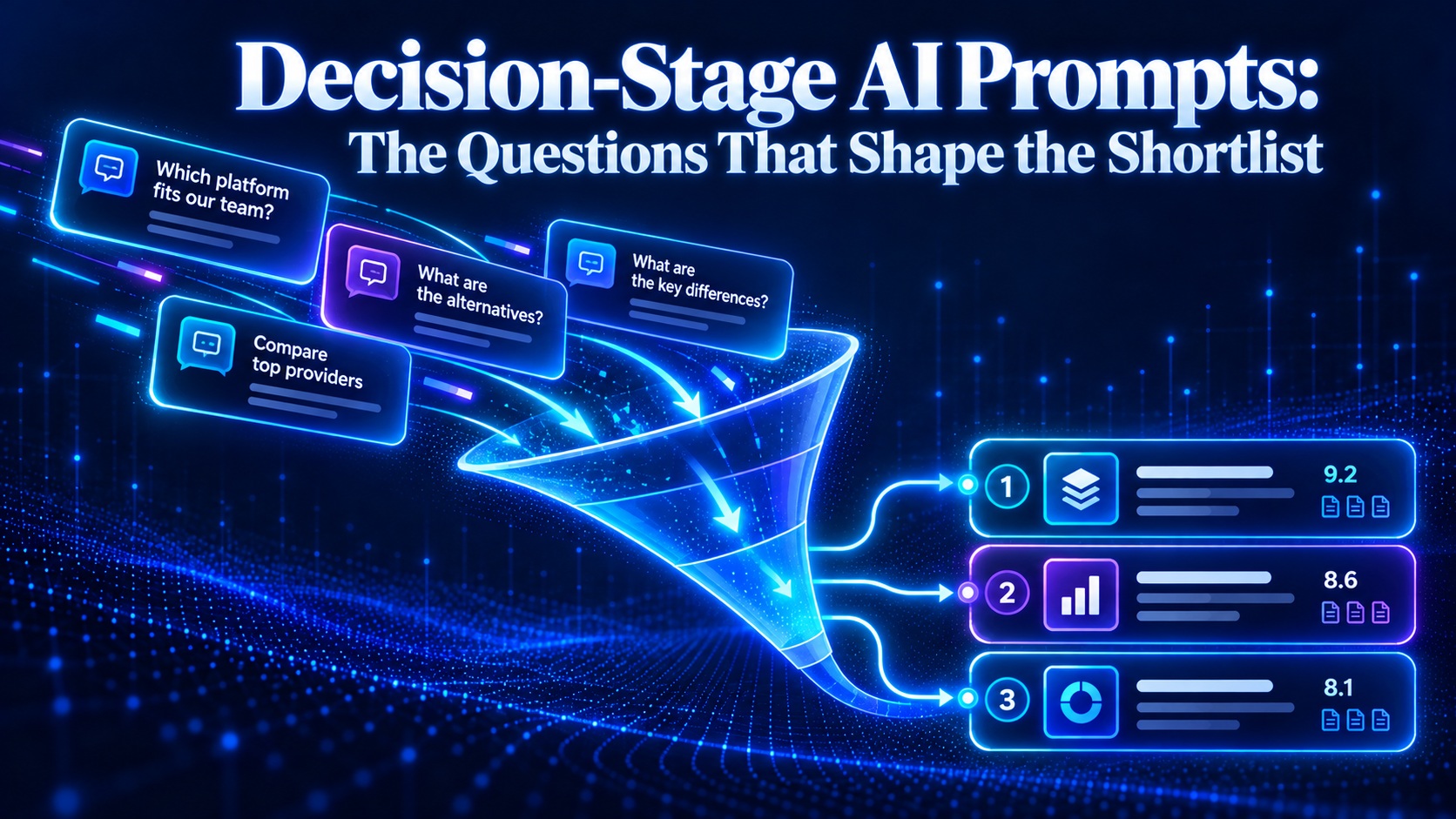
Semrush’s 2026 ghost-citation research found that comparative content produced 2.4x more brand mentions than informational content in its dataset. The same research also found that short, conversational queries produced far more brand mentions than long prompts.
That suggests a useful content distinction. Informational content can be excellent source material and still leave the brand invisible. Comparison, alternatives, best-for, use-case, and evaluation content is more likely to put named brands into the answer itself.
Signal 5: authority beyond your own domain
A common GEO mistake is assuming the company website is the entire optimization surface. In practice, AI systems may cite publishers, competitors, documentation, communities, video platforms, reviews, or other corporate pages.
Your owned content still matters. But if every positive claim about the brand originates only from the brand, the source ecosystem is thin. Independent corroboration makes the entity easier to understand and the claim easier to trust.
What does not look like a shortcut
Two findings are especially useful for avoiding wasted effort. First, publishing more pages by itself showed almost no relationship with AI visibility in the Ahrefs analysis. Second, raw backlink volume was much weaker than broad brand mentions.
That does not make content or links irrelevant. It changes the standard. Publish something because it answers a real buyer question or creates a referenceable asset. Earn links because the source is credible and relevant. Volume without meaning is a poor GEO strategy.
How to turn the research into an operating plan
- Map the prompts and topics where the brand is absent or weak.
- Identify the sources repeatedly appearing in those answers.
- Separate owned-content gaps from third-party authority gaps.
- Create or improve the page that should resolve the buyer question.
- Develop something worth third-party reference: data, research, examples, expert commentary, tools, or a useful framework.
- Strengthen video or multimedia coverage where the category naturally benefits from demonstration or explanation.
- Re-measure the same prompt set by platform instead of relying on a blended visibility score.
Where MetaFyAI fits
MetaFyAI’s Brand Intelligence connects top-level visibility with topics, buyer questions, sources, citations, competitors, and platform-level differences. That matters because a single global score can hide where the brand is actually understood and where it is absent.
The useful workflow is not “get more mentions.” It is: understand which mentions and sources matter for the prompts you care about, strengthen the missing evidence, and see whether visibility changes.
Next Steps
AI brand mentions are not created by one technical setting. They emerge from the footprint a brand has built across the web: what it publishes, what others say about it, how consistently it is described, and whether those signals match the question being asked.
The current evidence does not justify pretending we have a deterministic formula. It does justify a clear priority: build a brand that is easy to find, easy to understand, and worth mentioning in the places that shape the category. Use MetaFyAI to track these diverse signals, measure your true digital footprint, and optimize for the brand mentions that actually drive revenue.
See where your brand is mentioned, recommended, and cited across AI platforms.
Frequently Asked Questions