Does GEO Actually Work? A Practical Evidence Standard
The honest answer is not a yes-or-no slogan. AI visibility can be measured. Some outcomes can move. The hard part is proving that your intervention caused the change.
“Does GEO work?” sounds like one question, but it hides at least four: Can AI visibility be measured? Can a brand’s visibility change? Can specific interventions influence it? And can those changes be tied to business outcomes?
At MetaFyAI, we see that the first two are increasingly answerable. The third requires better experiment design than most vendor case studies provide. The fourth is still an attribution problem.
Key takeaway: Treat GEO as an experiment program, not a list of best practices. Establish a stable baseline, change one meaningful variable, keep a comparison group when possible, re-measure the same prompts, and report the uncertainty.
What the newest large-scale evidence tells us
A June 2026 arXiv preprint, Generative Engine Optimization at Scale, analyzed more than 100,000 prompt responses across more than 100 brands. It found large differences in baseline visibility by brand maturity and substantial variation in how different engines cite and frame brands.
The study is useful, but it should be read with care: it is a preprint, and the author is affiliated with a commercial GEO platform. It provides a valuable measurement baseline; it is not independent proof that any particular vendor tactic will produce a predictable lift.
One of its strongest cautionary findings is that sentiment is much noisier than presence. The paper reports that whether a brand is framed positively or negatively changed roughly 6.7 times more often than whether the brand was mentioned at all. That means a single positive or negative answer is a weak success metric.
What GEO can measure reliably enough to manage
- Mention rate: how often the brand appears in a defined prompt set.
- Recommendation rate: how often the brand is actively suggested, not merely named.
- AI Share of Voice: how brand visibility compares with a defined competitor set.
- Citation presence: which sources and URLs are used to support the answer.
- Prompt-level visibility: which specific buyer questions the brand wins or loses.
- Product or SKU visibility: whether priority offerings appear, not just the parent brand.
- Platform differences: where results diverge across ChatGPT, Gemini, Claude, Perplexity, Copilot, and Google’s AI experiences.
What a simple before-and-after cannot prove
Suppose you update a page and, two weeks later, the brand appears in three prompts where it was previously absent. That is encouraging. It is not proof.
Between the two measurements, the model may have changed, Google may have refreshed its index, a competitor may have disappeared, a new third-party article may have been published, or the AI response may simply have varied. If you want to say your intervention worked, you need to account for background movement.
A stronger 90-day GEO experiment
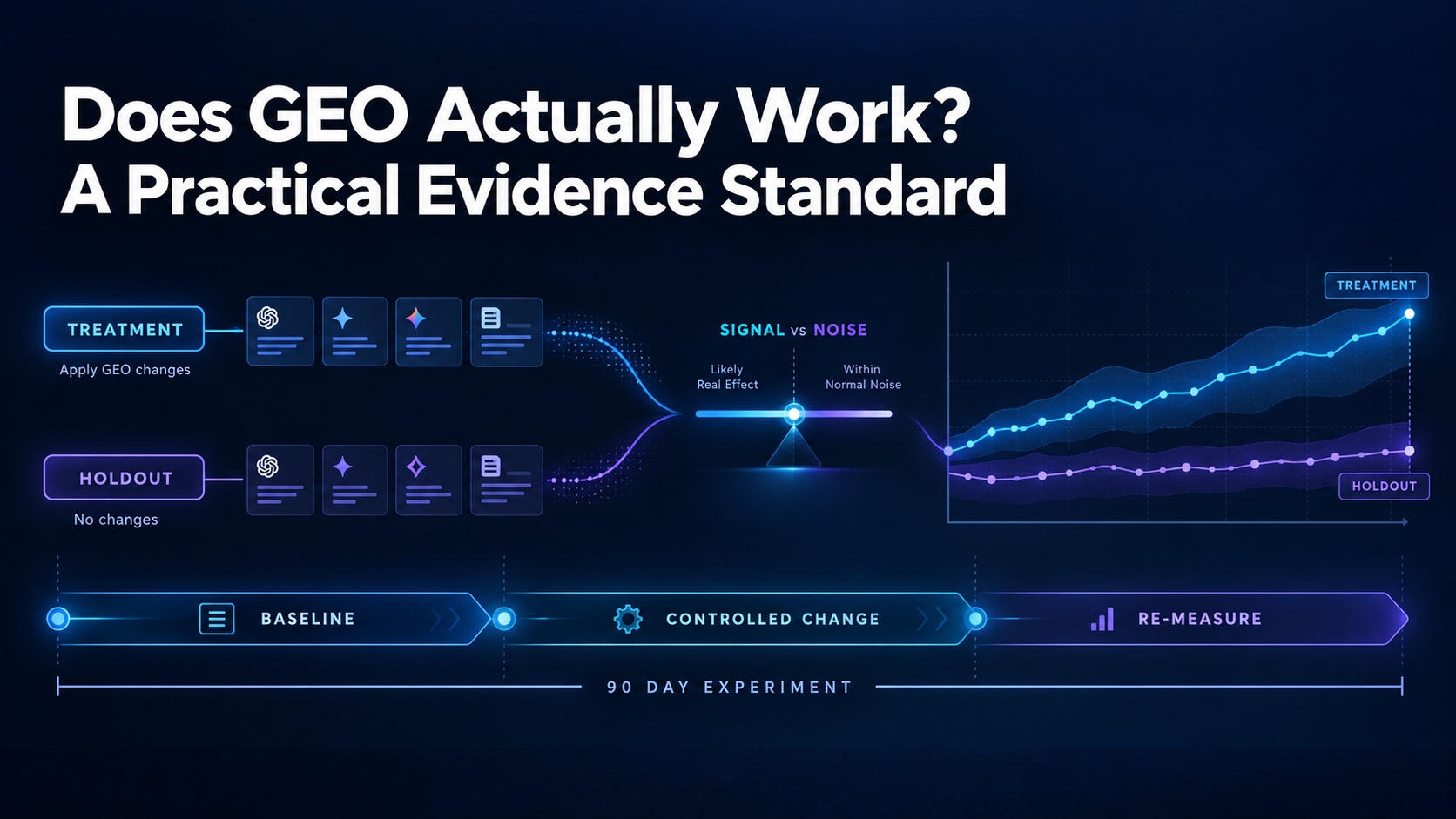
Ninety days is not a universal law. It is a practical operating window that gives most teams time to establish a baseline, make one controlled change, and observe the result over multiple measurement cycles.
Weeks 1–3: establish the baseline
Freeze the prompt set, competitor set, platforms, geography, scoring rules, and run cadence. Measure normal variation before touching the treatment pages.
Week 4: choose one intervention class
Examples: improve missing factual evidence, add a genuinely useful comparison, clarify product attributes, strengthen an underdeveloped topic page, fix crawler access, or earn coverage from an authority source repeatedly appearing in the category.
Weeks 5–12: re-measure without moving the goalposts
Use the same prompts and scoring rules. Track treatment and comparison groups separately. Document outside events that could explain movement.
Use a holdout when the conclusion matters
A holdout is a matched set of prompts, pages, products, or topics that you deliberately leave unchanged during the test. If both the treatment and holdout improve by the same amount, the lift probably came from the environment rather than your optimization.
Perfect experimental control is rarely possible in marketing. The point is not academic purity. The point is to avoid telling leadership that a tactic worked when you only observed a market-wide change.
Set a noise floor before you celebrate
Every AI visibility metric has normal movement. If mention rate tends to fluctuate by several points week to week, a tiny increase after an optimization may be indistinguishable from noise.
Record the baseline variance and define in advance what change would be large enough to treat as meaningful. That decision should happen before you see the result.
What Google’s guidance changes and what it does not
Google’s 2026 generative AI guidance says core SEO best practices remain foundational. That is important because it narrows the list of defensible interventions: useful content, strong technical access, clear information, and high-quality media remain valid work. There is no special switch that guarantees inclusion in an AI answer.
So the GEO test should not be built around folklore. Test changes that improve information quality, accessibility, evidence, or authority and measure whether the targeted visibility outcome moves.
What the day-90 report should contain
- The exact prompt set and platforms used.
- Baseline mention, recommendation, citation, and Share of Voice metrics.
- The intervention made and the URLs or assets changed.
- The holdout or comparison set, if used.
- Post-change results using the same measurement rules.
- Observed variance and the threshold used to define a meaningful change.
- Important external events or caveats.
- Business signals that moved alongside visibility clearly labeled as correlation unless attribution is established.
Where MetaFyAI fits
MetaFyAI’s core positioning is “Measure. Explain. Improve. Prove.”. That is a useful way to think about GEO because it keeps measurement connected to action. Measure the baseline, explain the gap with prompt, competitor, source, and site evidence, improve the right asset, and then re-measure the affected prompts.
The objective is not to turn every content edit into a scientific paper. It is to create enough discipline that the team can distinguish a real improvement from a favorable screenshot.
So, does GEO actually work?
GEO works as a measurable operating discipline: brands can track whether they are mentioned, cited, recommended, and compared inside AI-generated answers, and those outcomes can change over time.
What is not justified is the stronger claim that a particular tactic will reliably create a predictable lift for every brand or engine. The evidence base is still young, platforms behave differently, and confounding factors are everywhere.
The brands that win will not be the ones with the longest GEO checklist. They will be the ones with the cleanest measurement loop. Establish your baseline, run controlled experiments, and use MetaFyAI to prove what actually drives your AI visibility.
Establish your AI visibility baseline with MetaFyAI →
Request an AI visibility assessment and establish your baseline before optimizing.
Frequently Asked Questions