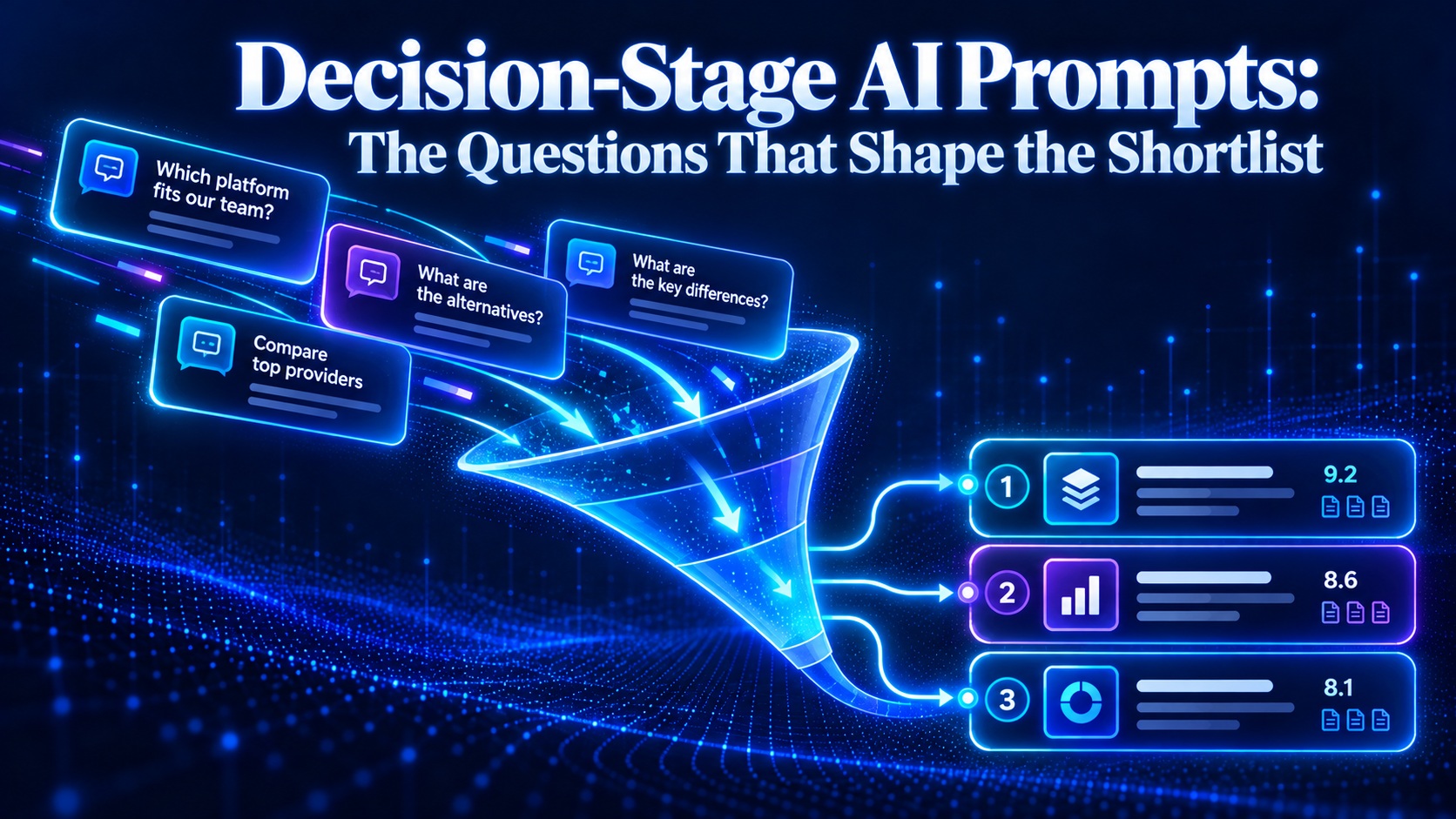
Decision-Stage AI Prompts: The Questions That Shape the Shortlist
AI buyers do not always search for your category. Often they ask which option is best, which alternative fits a constraint, or which vendor they should trust. At MetaFyAI, we've seen that those specific questions deserve their own dedicated measurement strategy.
The most valuable AI prompt is not always the one with the highest search volume. It is the one closest to a real decision.
A buyer asking “what is customer data infrastructure?” is learning. A buyer asking “which customer data platform is best for a mid-market retailer with Salesforce Commerce Cloud?” is narrowing a shortlist. Both questions matter, but they should not be measured or optimized the same way.
Key takeaway: Decision-stage prompt tracking should focus on the questions that change who enters the consideration set: best-for, comparison, alternatives, requirements, trust, risk, implementation, and fit.
Why prompt strategy changes at the decision stage
Traditional keyword programs often organize demand around search volume. AI conversations add more context: budget, industry, integrations, location, use case, team size, constraints, and prior options. That context can change which brands an engine recommends even when the underlying category is the same.
Semrush’s 2026 guidance on which AI search prompts to track makes the core measurement problem clear: the prompt space is effectively infinite, and the same question can produce different answers from one run to the next. Tracking everything creates noise; tracking too little hides the gaps.
The seven decision-stage prompt families worth monitoring
1. “Best for” prompts
These ask the engine to match a category to a use case: “best CRM for a 50-person B2B sales team” or “best GLP-1 nutrition shake for users who struggle to hit protein targets.” The key output is not just mention rate. It is whether your brand is recommended for the specific context you care about.
2. Comparison prompts
These force positioning into the answer: “Brand A vs. Brand B,” “compare X, Y, and Z,” or “which is better for enterprise security?” Comparison prompts expose the attributes AI systems associate with each brand price, fit, quality, integrations, credibility, support, performance, or risk.
3. Alternative prompts
“What are the best alternatives to X?” is one of the clearest signals that a buyer is building or revising a shortlist. A brand can have strong overall visibility and still be absent when buyers explicitly ask for alternatives to the category leader.
4. Requirement prompts
These combine the category with hard constraints: budget, size, material, feature, geography, compliance, platform compatibility, shipping, or technical architecture. These prompts reveal whether the brand’s product information is specific enough for AI systems to match it to the requirement.
5. Trust and proof prompts
“Is this company reliable?”, “is this product worth it?”, “which vendor has the strongest evidence?” and “which option is safest?” can reshape the final shortlist. Brand content alone rarely answers these questions; third-party reviews, expert sources, proof points, case studies, and customer evidence matter.
6. Implementation and switching prompts
Buyers may ask which tool is easiest to deploy, migrate to, integrate, or replace. These prompts often surface documentation, community discussions, support content, and implementation evidence that broad category pages miss.
7. Final validation prompts
The last prompt before action may be highly specific: “which of these three works with our stack?” or “what should I know before buying X?” These are small-volume questions with large decision value. They deserve attention even if no keyword tool assigns them impressive volume.
Do not turn prompts into a content-factory brief
Tracking 100 buyer questions does not mean publishing 100 pages. Many prompts share the same underlying information need. The job is to cluster them into decisions and make sure the right page product page, comparison, FAQ, case study, buying guide, documentation, or proof page resolves that decision.
A weak program creates one thin article per phrasing. A stronger program maps several related prompts to one authoritative asset and then measures whether visibility improves across the cluster.
Build the prompt set from real buyer language
Start with internal evidence before generating prompts from scratch: sales-call objections, support tickets, product reviews, on-site search, competitor comparison requests, customer interviews, and the questions prospects ask in demos. Then expand those patterns into neutral, brand-free questions that represent how a buyer might ask an AI assistant.
The brand-free part matters. If the prompt already contains your company name, you are measuring recall. Decision-stage visibility is more valuable when your brand enters an answer without being forced into the question.
What to record for every decision-stage prompt
- Was the brand mentioned at all?
- Was it actively recommended or only listed?
- Where did it appear relative to competitors?
- Which product, SKU, service, or capability was named?
- Which strengths or weaknesses did the answer associate with the brand?
- Which sources were cited?
- Did the answer change across ChatGPT, Gemini, Claude, Perplexity, Copilot, or Google’s AI experiences?
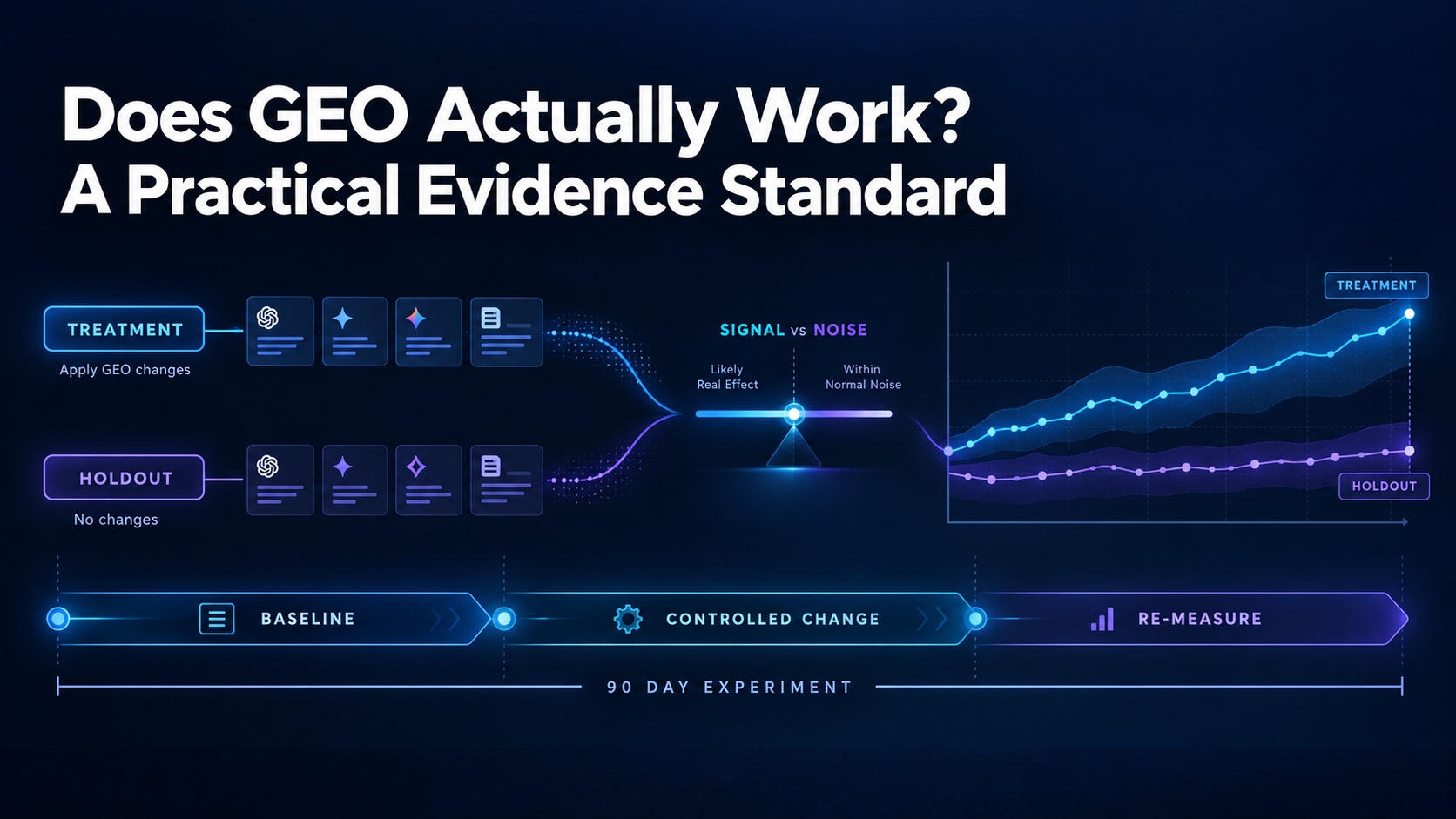
- Did the result change after a specific content, product-data, or authority improvement?
Where MetaFyAI fits
MetaFyAI’s Prompt Intelligence is built around this question-first model: discover relevant topics, review the buyer questions, monitor prompt-level visibility, inspect the responses and sources, and then re-measure the same questions after action.
That is especially useful at the decision stage because aggregate brand visibility can hide the exact moments that matter. A brand may appear frequently in broad educational prompts while disappearing from “best for,” “alternatives,” or feature-specific questions where a shortlist is actually formed.
A simple decision-stage prompt framework
For each product or priority topic, build a small balanced set:
- 3–5 “best for” prompts
- 3–5 comparison or alternative prompts
- 3–5 requirement / constraint prompts
- 2–4 trust or proof prompts
- 2–4 implementation / switching prompts
- 2–4 final validation prompts
Freeze the set for a measurement window. If a new buyer question becomes strategically important, add it deliberately and mark the date rather than silently changing the baseline.
Next Steps
AI visibility is most valuable when it reflects the decisions your buyers are actually trying to make. Do not let a giant prompt list become the strategy. Use a focused set of decision-stage questions to reveal whether your brand enters the shortlist, why competitors appear instead, and what evidence the answer is using. Then, use MetaFyAI to monitor these critical prompts and measure your true impact over time.
Compare your brand against competitors on the buyer questions that shape the shortlist.
Frequently Asked Questions